
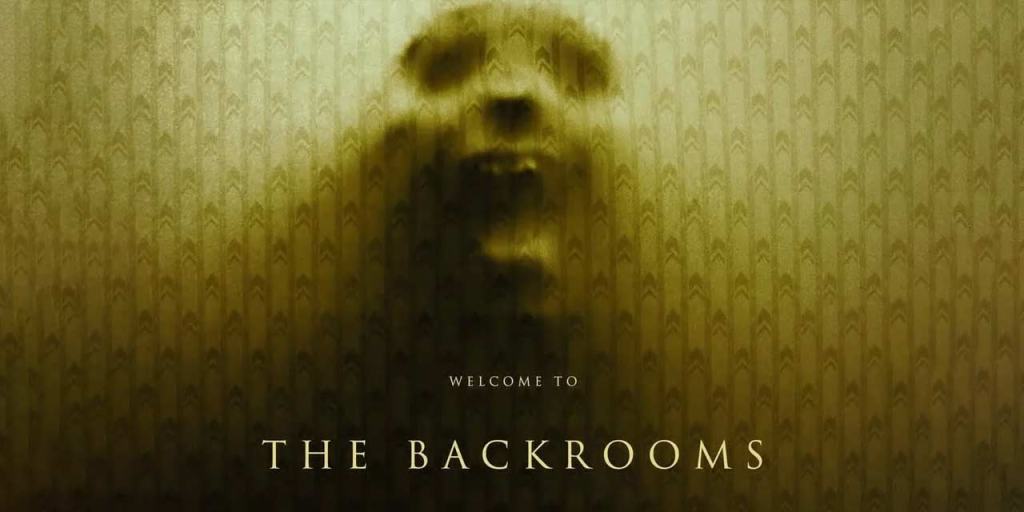
Directed by Kane Parsons
Welcome back, everyone! Or should I say…welcome “backrooms”! Now that I’ve alienated everyone with a horrible pun, thanks for coming here to read what I have to say, it’s been heartwarming to hear from people about wanting more movie reviews. I’m not totally caught up with current releases (you’re next, Disclosure Day) but I have seen the newest success story from A24, the internet horror sensation The Backrooms. While this isn’t even close to the first internet horror meme movie, that’s still a category that comes with a lot of baggage, I was excited to see if Kane Parsons could expand his own (in my opinion pretty great) horror short into a feature, so let’s not waste any more time and see if I can survive a trip to the Backrooms!
Set in 1990 after a series of unpleasant events, local entrepreneur Clark is desperate for any way out of his current situation. Struggling with a failing furniture store, alcoholism, and his love life imploding, Clark doesn’t have much going for him. That is, until he discovers a secret entrance into a bizarre space seemingly inside/adjacent to his furniture store, and immediately becomes enamored by this strange finding. Trying and failing to convince his therapist, Mary, that he found this wondrous space, Clark makes an impulsive decision to look deeper into the Backrooms, risking not only his own life, but the lives of the people he brings along. Unbeknownst to anyone, a mysterious third party also seems interested in these ‘Backrooms’ but the reasons are unclear.
As usual, I want to start with what I liked about the movie, and there is a lot to like about the Backrooms. First and foremost, the atmosphere is a perfect liminal space nightmare. Everything is slightly off without being too strange, giving every sequence in the ‘Backrooms’ area a bizarre and unique feeling to it that takes over large parts of the movie, almost acting like another character. Combine that with the mazelike structure of the ‘Backrooms’ and you have an effective horror setting, especially when we get little snippets of found footage, which, as a found footage horror junkie, was where The Backrooms really shined. What makes the found footage sequences so great is that combination of liminal space horror and the analog vhs camera recordings, two great tastes that taste great together, showing you just enough to be freaked out while not showing too much at any one time.
While on the topic of what works here, I would be remiss not to mention the performance of Chiwetel Ejiofor, who completely carried the emotional aspects of The Backrooms. His performance as Clark grounds the movie and creates a character that is easy to both empathize with and root for, I wanted Clark to tackle his demons head-on and search this strange place for answers that eluded him in his life in the real world. There’s a particularly heartbreaking sequence where Clark delivers a painful monologue about how he’s experienced the world and what he wants in order to feel okay again, and Ejiofor delivered this with such emotional investment that it couldn’t help pulling at my heart strings a bit. The other actors aren’t really bad, but they don’t have the same presence or even as many good lines as Clark.
While the atmosphere and lead performance are great, sadly not all of The Backrooms can match up to these highs. Unfortunately, the narrative of The Backrooms is kind of a trainwreck. The basic plot line works absolutely fine, Clark is interested in architecture and finds the Backrooms to be a fantastical place that shouldn’t exist, giving him a chance to explore something magical outside of his mundane and rather depressing life. Where things get kind of wonky is when the larger narrative of the story kicks in and starts trying to make the movie be about things. Behavior loops are brought up over and over again, which are patterns of behavior that people can find themselves in even if the patterns are bad, but this concept is never cleanly connected to the idea of the Backrooms beyond the simplistic notion that, as a maze like structure, you can get lost and ‘loop’ inside of it. Any attempt at linking behavior loops with the characters here falls flat because we never see anyone actually engaging in them, ever. Without any spoilers, the story can never solidify itself and figure out what it’s trying to say or how to say it.
In the same vein, the pacing is all over the place. Almost the first hour of the movie is incredibly slow, gingerly explaining stuff about Clark’s life and showing him at odds with a failing business, alcoholism, and a non-existent pool of friends or family. It’s quite repetitive and could easily have been condensed to get to the actual interesting bits, which is the stuff with the Backrooms or maybe even Clark’s relationship with his coworkers or his ex-wife. Fortunately, the middle third of this is kind of great, there’s good escalation, almost all of the really scary bits are in the middle, and the Backrooms get way more fun and out there. Unfortunately, the climax is a complete mess, stripping away everything that worked and leaving the movie with plot points that are either meaningless or vaguely problematic. I’ll get into spoilers down below, but it was a massive belly flop.
There were a lot of things about The Backrooms that I enjoyed, and even though I focused on a lot of problems I had with it, that doesn’t mean that it’s a bad movie. In terms of atmosphere, the main performance, and the impressive practical sets, The Backrooms succeeds at translating liminal horror to the big screen, but unfortunately the writing collapses in on itself and lets down all that hard work. Given that this is the first feature film of Kane Pearson, this is not a bad start at all, I’m looking forward to his next project and I wish him the best. Whether or not you should see this movie really hinges on one question, do you find weird office spaces unsettling? If not, maybe wait to rent this one.
MASSIVE SPOILERS BELOW
While this isn’t a website dedicated to discussing the intricacies of talk therapy or societal attitudes toward mental health as a whole, when a movie claims to focus thematically on mental health, it’s totally valid to discuss how it handles that topic. To that end, The Backrooms handles mental health extremely poorly. Like, embarrassingly poorly. I don’t claim to be an expert, but I have a lot of experience dealing with mental health professionals (take that how you will), and there were so many moments where what I was seeing did not mesh at all with what I was expecting.
To put this in perspective, an important aspect of the plot is that Clark is seeing a therapist after he splits with his wife following an explosive argument regarding finances, his job, her schooling, and his alcohol abuse, with this scene showing Clark’s anger and bitterness towards his ex. This plot thread follows Clark throughout the whole movie and culminates at the climax of the film where his therapist confronts Clark and blames him for all the problems in his own life, saying that his “whining” drives everyone away and he can’t “blame his brain” for his inability to connect with people, as Clark doesn’t really want to change.
Clark is defeated by this verbal beatdown, and it seems like it is supposed to be accurate, but the problem is that almost none of what the therapist says seems to be true. We aren’t shown anything about Clark’s ex or the argument they had except Clark’s words, so all we really know is that there was a massive argument which led to their breakup, which, while unfortunate, doesn’t make Clark a monster. Add to that, every time we see Clark frustrated or upset or turning to alcohol, he’s dealing with something understandably shitty; like vandalism of his store, furniture breaking while he’s trying to film a commercial, or his power bill being unexpectedly high while he’s drowning in bills. These aren’t minor things, they’re daily stressful events that keep dragging him down without a way out, which would make it pretty hard to just “get over” them and fix his life, which was what his therapist oh so helpfully suggested he do.
And while we are mostly just told that Clark is angry and whiny, we need to look at his situation in the context of his time and see what that says about him as a person. It’s the year 1990 and Clark is a man who has, as far as I can tell, voluntarily sought therapy to help him with his problems. Even today, there is a stigma for seeking mental help, so just imagine how much of a stigma there was more than 30 years ago, especially for a man, where the idea of ‘needing mental help’ would make you seem weak. This goes doubly for Clark because, as a black man, there are all sorts of additional stereotypes and societal expectations implicitly thrown his way about reaching out for help like this. All that in mind, seeking out mental health treatment because he’s in a terrible place mentally isn’t just smart, it’s brave, and speaks to an awareness of his own faults and problems that he knows he can’t fix on his own.
Clark tries to convince his therapist he found the backrooms but she doesn’t believe him, so when she finally checks up on him and finds him in the backrooms, where he’s withdrawn to and is losing his mind, her final act to him is to tell him how terrible he is before he unceremoniously dies and we then follow the therapist for the rest of the movie. It’s a bizarre sequence, especially when immediately afterward, the therapist is chased by a large, grotesquely misshapen version of Clark, turning the climax of the movie from a character study of a vulnerable and pained black man into one where a white woman is chased by a large grotesque angry black man. It’s a very weird turn, particularly as we know very little about the therapist, just a few snippets telling us she has childhood trauma.
I don’t want to accuse this movie of being purposely racist, I don’t think that’s the intent. What I will say is that there seems to be an undercurrent of biased thought that has appeared in the narrative, with or without the intention to be harmful. Clark’s ex wife, who is also white, is never seriously talked about in a way that suggests she had any responsibility for their bad relationship, Mary’s inability to help Clark is only framed as Clark’s fault, Clark is the only person who gets branded the “angry black man” and it is implied the he deserved his fate because everything is his fault. The white women are portrayed as innocent and blameless, the black man angry and violent. This could have been avoided if there were any other named character of a different race but there isn’t which is another problem altogether.
The easiest response to this would of course be that this is just a movie and I’m reading too deep into some simple plot points, which is, of course, absolutely untrue and you should feel bad if you think that. A more reasonable response would point out that this is probably a reverse Night of the Living Dead situation (where a black actor played a character whose race wasn’t specified, and this added layers to the social commentary of the movie), where they didn’t necessarily plan for Clark to be played by a black actor and all the subtext came out accidentally. In all fairness, that’s probably what happened. But this doesn’t change the fact that casting is an important part of narratives, it changes things, adds or removes context to characters’ lives and experiences. Ignoring that doesn’t do anyone any good, especially with such heavy topics like mental health, psychiatry, and relationships.
That’s the end of my way too deep dive into the racial politics at the heart of The Backrooms, a topic that I’m sure everyone is deeply invested in. If you’ve made it this far, I am extremely humbled by your willingness to read my nonsensical trains of thought and I hope you’ll be back for more of this. I can’t guarantee that I’ll be able to create a socio-political analysis for every new movie, but by god I will try. Stay safe everyone.