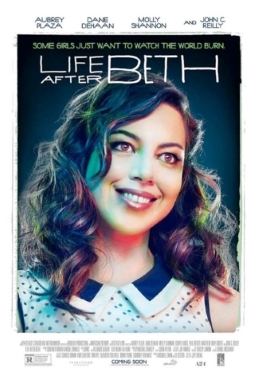
Directed by Jeff Baena
We’re on day 4 of Zombie week and I noticed a pattern repeating with my choices. All my movies so far have been having to deal with apocalyptic zombie scenarios, hordes of the undead rising up and needing to be put down. This is an extremely common type of zombie movie but it isn’t anywhere near the only kind of zombie movie that can be made. Case in point, our movie today, Life After Beth, explores what can be done with zombies and what they could mean beyond the jibbering hordes that audiences are familiar with.
The story begins with the tragic passing of Beth, hence the name of the movie. Her boyfriend, Zach, struggles immensely with this, and maintains contact with Beth’s parents through this ordeal, despite his own doubts about the lifespan of his relationship with Beth. On one visit over, Zach spots Beth in her parents’ home, and although they initially deny it, Zach learns the truth, Beth has returned from the dead. Initially, Zach is thrilled to have Beth back in his life, but soon starts to notice that Beth isn’t always acting like herself, and that some other people around town have also been exhibiting some strange behavior.
Aside from the excellent cast, which includes Aubrey Plaza, Dane DeHaan, and John C. Reilly, the best part of the Life After Beth is its story. While this shockingly isn’t the first movie to use zombification as a metaphor for grief and romance issues, shout out to Return of the Living Dead 3, I’m a huge fan of this type of story, especially with the use of a creature that so often is a blanket metaphor for the evils of mainstream society. Going more personal, more emotional, and less bombastic is always something I welcome.
While I appreciated a lot of the elements of this movie, it never fully came together in the ways I was hoping. I enjoyed the actors, the premise, and the overall mood, but this movie hit me the same way that a lot of higher concept movies do where they have a point they want to make, they’re really into that point, and don’t realize that their point doesn’t need to be the subject of a feature length film. There’s an incredible short film buried in here, but not quite enough to sustain this as the core of an entire movie.